The above is part of a creative writing assignment I assigned to my students during the Reconstruction unit. After covering the hard facts and content of this period I wanted to give the kids the freedom to express the information they had learned in a medium where they had practically complete control. The only parameter was they had to pretend they were writing about Reconstruction as if they were actually there. It was an opportunity for them to flex their writing capabilities and in a way express themselves in how they like to think of things and the world and such. The assignment also served the purpose of having them reflect on what they knew/remembered about Reconstruction, and they had the freedom to ask questions to me and Brian as well as look up information. So it was a stealth research/retention assignment where they had the freedom to approach it as they saw fit. Now not every entry was as great as the one linked above, but it demonstrates what the kids could do on their own initiative just a prompt and some information.
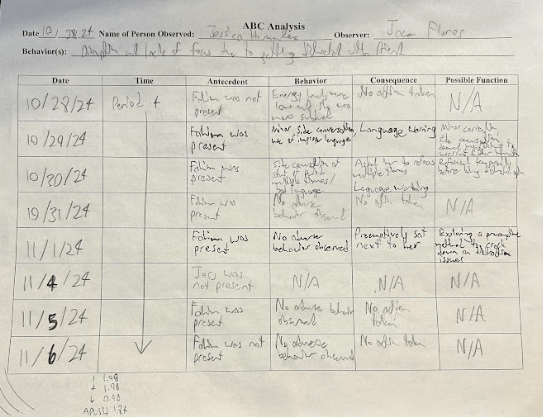
During the course of the special ed assignment we had to do for Jen Phuong I observed a student of mine who agreed to be the subject of this assignment. The basis of me picking her was she can goof off quite hard in class and get distracted from doing the work, which seemed like a good sort of low-stakes thing to do this assignment about. The logical idea I explored is her efficiency with doing the work by minimizing her sociality as much as possible, particularly with her best friend. This was immediately observable when I sat in on her English class where her best friend or any other close friends of hers were not present. And what I noticed was a profound sadness. The joy and exuberance she brought to period 4 was nowhere to be seen, I don’t recall her smiling once. Now the idea mentioned above was right, she got her work done in the class exceptionally well and fast, having no distractions to hinder yet. And yet, it just seemed plain wrong. It was this observation that made me realize the importance of class not just being about getting the work done as quick and effectively as possible. It’s not worth it if the students are downright miserable (or at least look miserable). In my mind it became immediately more acceptable that the student in question have her moments of sociality and distraction, because it brought an energy of joy that was just as important to the class as her doing the work. Now obviously she has to be reined in once in awhile because there is such a thing as too much distraction, but there needs to be a balance because miserable working students is just not worth it.
Something that happens regularly after a lesson is done and Brian and I have time is we reflect on the lesson. I myself am a very self reflective person and constantly calculate in my mind what things have gone well, what things are permissible if not necessarily optimal (perhaps a slight watering of things down for better understanding or ability for students to do it) and what things plain did not go well. Brian and I will discuss these different things and he will either pitch his own ideas or I will pitch mine on further strengthening the lesson. Lately I have been in a pretty good flow but particularly in the first weeks of student teaching these conversations were invaluable in strengthening my lesson plans to better achieve their overall purpose. Importantly, this feedback was incorporated immediately so that for the next period I taught they would have a much better and effective learning experience. This did create a humorous situation where one period served as a guinea pig and the other had a more effective lesson. Thankfully the periods alternated on when I had them first so there was equality in who kinda got the short end of the stick. Nevertheless, these conversations were instrumental to the stride that I think has been achieved lately, and hopefully in the long run.
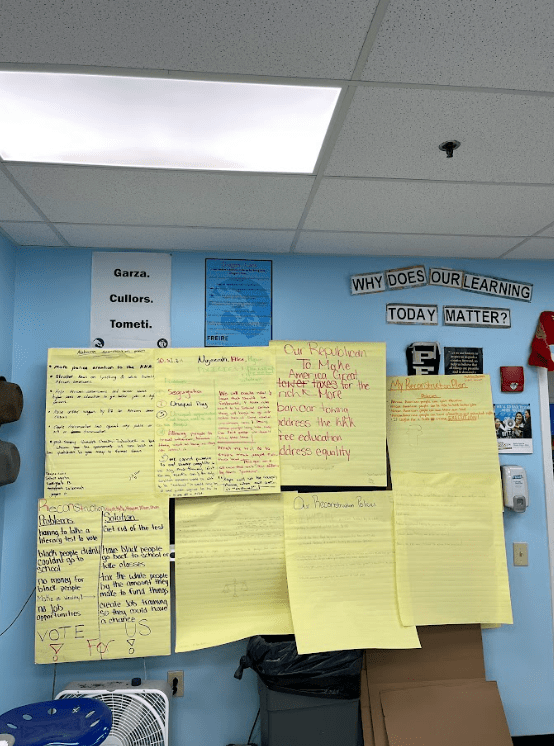
As the capstone for the Reconstruction unit, I crafted a simple activity where the kids were sort of simulating being in 1870s America. The premise was they had to imagine it was 1872 and they were running for governor in an unnamed Southern state, with their victory guaranteed thanks to expected black votes. What they had to do was create a platform to address the issues of Reconstruction, keeping in mind that they had to balance the practical with the ambition. So no promising everyone a million bucks but more then simply promising to give voters hugs.
The assignment was interesting because the students had free reign to approach the assignment as they saw fit. Obviously if they had questions or wanted to run ideas by me or Brian they could. But otherwise it was up to them and what they learned about Reconstruction to devise solutions for the issues of Reconstruction with no real right or wrong answers.
This made it quite interesting because the students had the same information, but applied it in different ways. Some were rather draconian and advocated for high punishments and executions of white supremacists. Others emphasized economic equality with land ownership and education opportunities. Most stayed in the time period (as told in the instructions), but 1-2 groups dabbled in modern issues, which was an interesting look at the political issues they had heard of. This assignment took two days to do with presentations being done on the second day, and it was really interesting hearing the students having different answers to the same issues. As the assignment intended, but frankly the diversity of thought was more then I expected.
The assignment overall did a great job in teasing out how the thought processes of these kids are very different even when given the same information and instructions. This assignment allowed them to flex their diversity of thought, and hopefully will be something that can be exercised in the weeks left in the program.
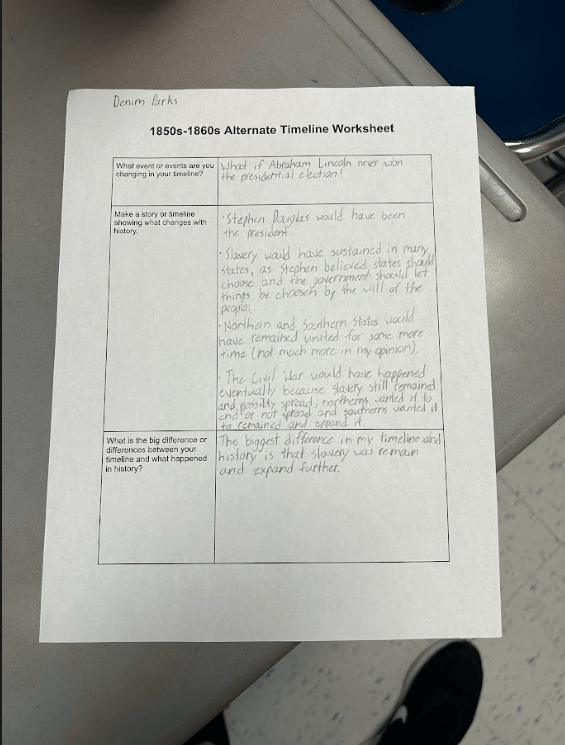
This was the culminating lesson for the Civil War unit where the kids had to write an alternate timeline on the Civil War (or run up to the conflict) based on what they knew, what they had learned and what they researched. Admittedly it was a bit of a gamble because I had never seen this done before and the kids can be variable on their ability to do things. Sometimes they can conquer the world and sometimes they can’t walk two feet forward. I created this worksheet with three questions and, to prime their minds, I started with a warmup asking “Have you ever thought about an event in your life going differently, and what that would have looked like?” A low stakes easy to do what-if that is essentially an alternate timeline.
From there I gave them the worksheet and projected an example I did on John Brown’s Raid, showing them how it could be done. After that I told them not to copy this example (obviously) and to use their Chromebooks to research as they saw fit and use much of the class in order to fill this sheet out. Surprisingly, things went exceedingly well. There were some clarification questions unsurprisingly, but the kids were really engaged with the activity. There were only 3-4 people out of 60 classes in two sections that did a what-if based around the movie Glory, which was a lot lower then I expected (and those who did a Glory what-if put in the work, nothing was phoned in). The example above is a particularly good example of a what-if the kids did.
At the end of the period we had three kids volunteer to share their timelines and they were all good, having different events and themes. You could tell that they were putting their information to use.
Overall the activity was a major success. The kids used their information and creativity to write these interesting and engaging stories, which I think was helped by the freedom they had to write about what they want in the time period given. So some wrote one’s as small scale as what if Frederick Douglass never ran away, to what if the CSA won the Civil War. I think a signal of how successful it was was that Brian and JB (a cooperating teacher for 1st period only) both said they were going to adapt the assignment for their own unit plans, and these are teachers with almost four decades worth of teaching experience. So major success! I think doing these kinds of more freehand one off assignments is a good way to cap off a subunit for the kids to express their creativity and have more fun.
I will keep stressing this one, but the community that has been built in Brian’s class has been a triumph I think. While it has not made productivity, focus or classroom management perfect, it has been very helpful with these. The sort of personal bonds had make directions or instructions more friendly if that makes sense. I think it is particularly noticeable when we have weekly meetings with the other 10th grade students and hear what other kids are up to the teachers deem worth bringing up. A lot of the students brought up have been pretty good/cooperate in our classes despite struggling in the other classes, which I think in large part is from the community building that was established. You can also see the contrast in the crew class where things are significantly more difficult to get students to buy in, with a big difference is we had no time to get to know the kids and adjust them before diving into the crew content. Again, I think this just highlights how vital establishing community is at the start of the year as it has a cascading effect on the outcome of the following weeks and months.
Observation 2: Learning Style
Something that is very different with virtually any type of class I have taken is the emphasis on group work. Usually Brian will start with a warmup and have a bit of a content primer, no longer then a few minutes. He will then pass out papers or packets which have the instructions and content they need for the period, with the kids working in groups to read the content and answer some questions had on the instructions. I quite like this for a variety of reasons. The first is that it encourages the kids to work together and cooperate, which I think is very important as cooperation is something which can serve the kids well throughout their lives. The second is it allows for better monitoring and assistance, as me and Brian can come around to the different groups, check in and provide any help they need. The more personable aspect of this makes a lot of this management and assistance more effective. The third is that, frankly, for me there is a lot less anxiety with group work focus then doing full class work that makes it more comfortable for me as well now that I am teaching.
Observation 3: Energy Level
An interesting thing to see in the different periods across different times and personalities is the energy levels of a class. Generally speaking classes seem to be the most cooperative and productive in the morning, presumably after many of the kids have had coffee and are not drained from school work. This generally holds until after lunch time. The post-lunch time classes are interesting because there are a wide array of possibilities. The most common, unsurprisingly, is the kids are bouncing off the walls with energy and are harder to manage and get/stay on task. The next most likely possibility is a sleep coma state where the kids fall asleep in droves and are very low energy after being roused back. The least likely possibility is the kids have comparable energy to morning sections. Interestingly end of day sections (of which there is one) are fairly similar to morning periods in energy levels, perhaps buoyed by the prospect of school ending. Class personalities also have a major effect. Period 4 is very energetic with the most disruptors, Period 6 is energetic but to a healthy degree, a nice balance between personality and productivity, and Period 1 is rather sublime.
For my Microteach I decided to teach about the Articles of Confederation.
I started with a warmup asking the students to make their own set of laws as if they were leading their own newly independent nation. They could work with a partner or buy themself, and have some of the students share out what they wrote as a simple participation effort.
The next section was a historical lecture on the Articles of Confederation, starting with the background (namely what led to the outbreak of the American Revolution), then what the goals of the Articles of Confederation were, and ending with how the articles were implemented and eventually suspended and superseded by the Constitution.
The culmination of the lesson is a simulation where the kids would be divided into groups, with one group representing the federal government and the other groups being different states. Every group would be given objectives that they had to accomplish as well as parameters for how they could operate (particularly the Feds who are purposefully hamstrung). A state group would go up to the federal group and pitch their problem and possible solution, with the Feds having to try and resolve the issue while sticking to their parameters. The goal of the simulation is for the Feds group to deliberately fail in order to highlight how the Articles of Confederation were doomed.
After the simulation there would be another mini lecture breaking down in more detail why the articles failed and how that led to the Constitution.
Overall I think this microteach is a glimpse into a past sense of how I actually like to teach. My time at Freire has been quite illuminating on how to avoid lecture and emphasize group work over teacher-class work. However, I do think the creativity I have is evident in the simulation which if actually practice I think would have been quite fun. Unsurprisingly the content is quite good and I think any students who participated in it would have been quite informed and hopefully had a little fun even with the lecture emphasis for much of it.
I think the most important thing I observed the past couple weeks is the importance of establishing environment. Brian emphasizes the creation of a warm, inviting and friendly environment to try and balance the personalities of the kids with the expectations of work. Kids are given leeway to do some things many other teachers would not tolerate, such as talking to each other, putting their heads down, doodling a bit, and so on. There are boundaries of course to the limit of this and Brian makes this clear by asking the class to refocus if the level of distraction is too much. But in essence the kids are allowed to be themselves, which I think helps with building trust, teacher-student camaraderie and getting them to focus when the teacher wants them to.
Something that was interesting on a school level and seeps into all the classes is that Freire has a pretty comprehensive set of values and expectations that they really push. Many if not most schools have these, but Freire is interesting in that they are not necessarily lip service to get some brownie points and never actually do anything with. Freire is clear and repetitive of what it expects of the students and their education, with teachers incorporating aspects to varying degrees as they see fit. Some are practical things like no food or phones must be in YONDR pouches, while others are more abstract like be a mistake maker or be a self-advocate.
With the students I have observed some pretty positive things. The students are fairly well behaved overall (mercy on those teaching right after lunch), and I think a large part of that is the environment facilitated in the class. For example, kids I shadowed from one history class to a subsequent math class went from being pretty jovial to being stressed out and frustrated. The kids notably have pretty good critical thinking skills and are not afraid to diverge from each other in their answers to complex or nuanced questions. Can they be frustrating and very distracted? Yes, but they do seem invested in doing the work and doing it well, even if it is just for a grade at the end of the day.
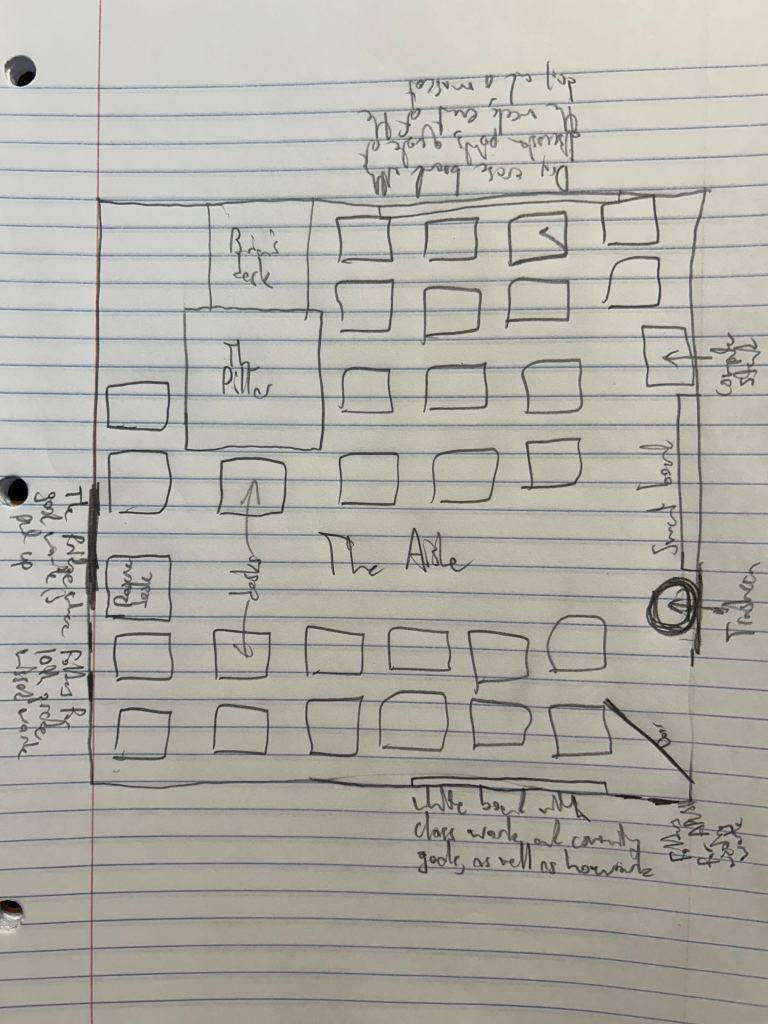
The classroom, Room 311 or Mr. Brian’s Room as it may be called, is tight. Both literally and metaphorically. Literally speaking the classroom is constricted by a lack of space relative to the student size (and it is likely we will be taking on more 10th graders the week of 9/9 that will make this worse), so the maneuver room is veering on nonexistent. On a more metaphorical room, Mr. Brian has designed the space quite well to be inviting and thematic without being gaudy or excessive. There are history related posters on the wall by his desk, some Penn State mementos on The Fridge wall and next to the smart board. He also has a pride flag and BLM flag near the fridge to show his support for these respective causes.
On a more practical level each wall has a surface which serves its own function. The most important is the smartboard where Mr. Brian displays everything, such as the agenda, warmup, instructions, exit ticket and so on. It seems rather intuitive to use and naturally Mr. Brian has his laptop connected to it (though he has a personal laptop to handle things that don’t need to be displayed on the board, like reviewing student answers, handling emails, etc). The Fridge is a poster which is designed vaguely like an LG fridge, with the purpose of being a space where Mr. Brian can hang up work he considers exceptional. So far there has been one piece of work he has decided to put up on The Fridge. The wipe board by the door is for logistics where the daily community goal, class goal and homework is written for the 10th grade and APUSH. Not much else to this board. The last wall has a more fun wipe board that contains the quote of the week, history event of the day, a scoreboard for class participation points and a large mascot in the center. Students can guess what the mascot is by writing the answer on a slip and putting it in a nearby box. At the end of the week he randomly draws guesses and the first five to get it right are put up on the board and given some bonus points. A fun community building activity.
Now given the lack of room in the classroom there is not a lot of customization that can be done with desks, but I think Mr. Brian has done a good job. He has the desks split in two halves facing towards what he calls the aisle, which allows him to walk up and down the classroom to get a good look at the bulk of the students, particularly useful for when they do group work. He has the desks largely arranged around multiples of four because the students frequently do group work in fours, with the kids turning their desks in place when working (an efficient product of the lack of space). It is hard reaching the kids in the back near the mascot white board, but there is not much that can be done given the lack of room.
Overall I think given the major constraints in physical space Mr. Brian has done a good job in arranging the room to facilitate maximum teacher-student interactability and having the kids being able to work together or see the smart board. The walls are intelligently used for practical and fun purposes. We just dread having more students crammed in.
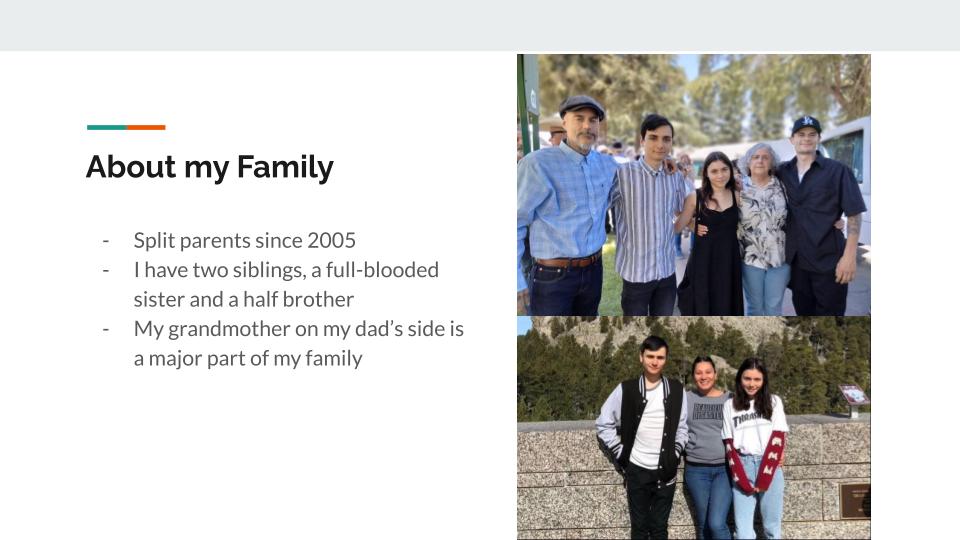
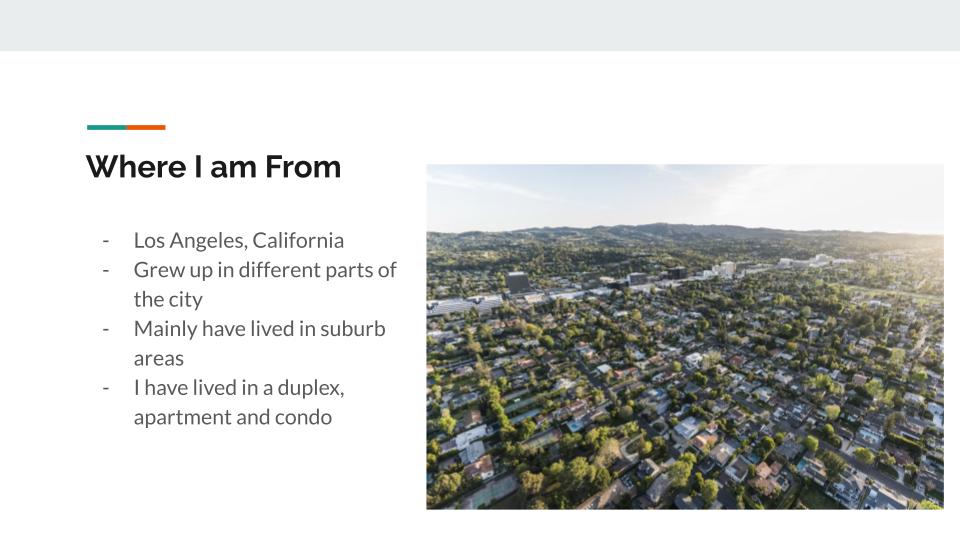
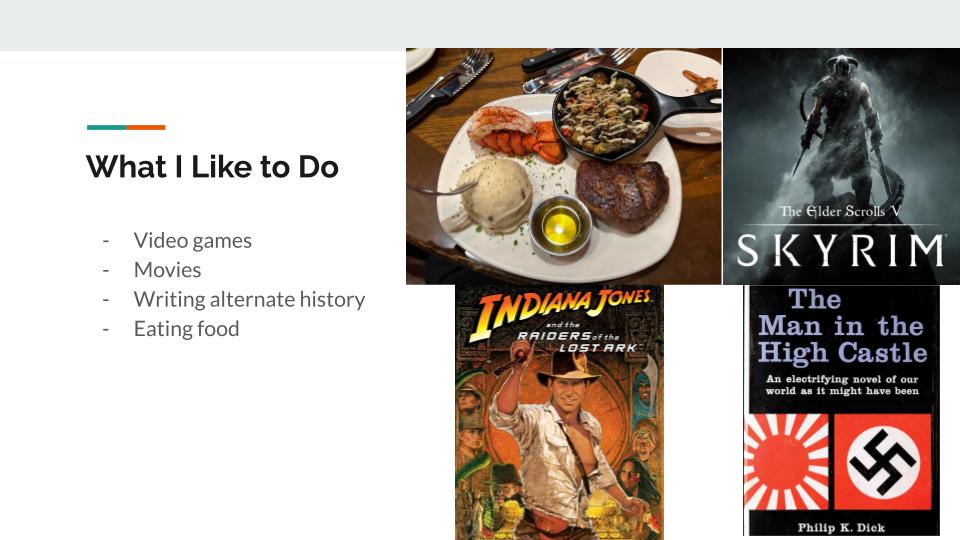
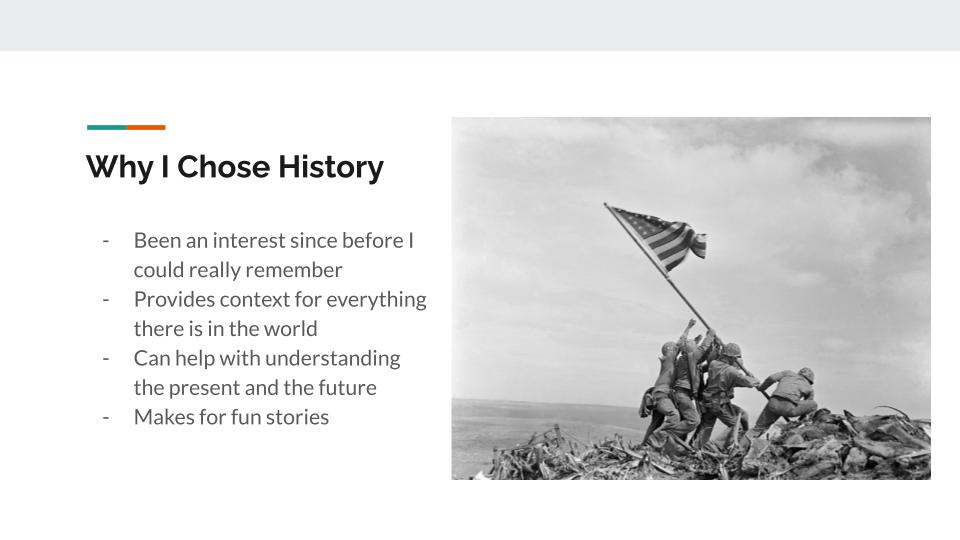
Teaching my group was fairly awkward given we were essentially trying to act in a school environment with school children. So there was a lack of authenticity. I did use a couple of these slides with the students, and Brian had the fun idea of incorporating one of the facts (namely where I am from) as a bonus question for the first exam. The feedback from what I remember as limited in its usefulness.





 Jace Flores Student Teacher Blog