Jace Flores Student Teacher Blog

    • Planning & Preparation

  • Special Education

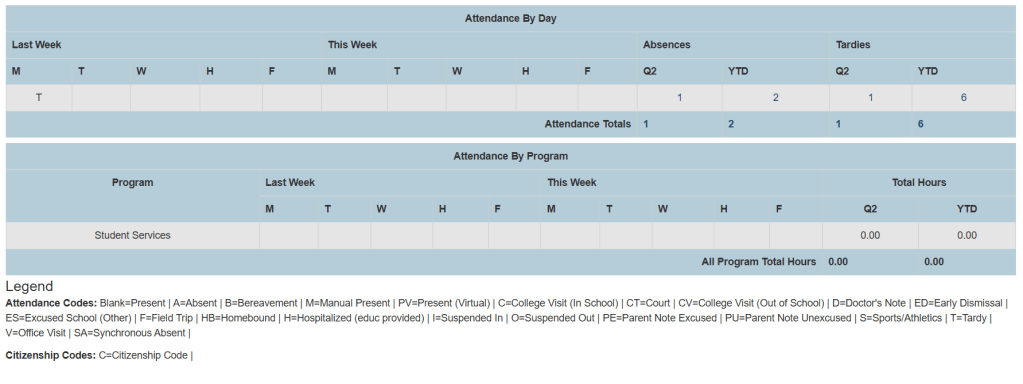
    I think perhaps the weakest spot I had was accounting for special education students. At Freire they are called Student Services or SS for short, and are students who have some sort of additional educational need. They have staff dedicated partially towards helping these students and monitoring their progress in other classes. In my classes we had a fair few SS students, particularly in 4th period, which I think helped with the weakness. I did not take over 4th period until later in the student teaching period and thus simply imported my methods from the other periods to this one. I did not make work dedicated to them and relied more on grading on a curve and having them do a few of the questions. A janky system in hindsight not the best suited for their needs. Another part was I did not know which students were actually SS, which in part was because Freire never shared that info with me (which I think would have been a smart thing to do) but also lack of initiative on my end to seek that info out. I did not think about doing that until the end of the period which made it fairly pointless. I guess if there is a silver lining is I have quite a few lessons on what to do now to better support SS kids in the future.

    December 16, 2024

  • Keeping Things Fresh

    Something I became aware of as time passed on was that certain activities started to get stale. If I did the same activity four to five days in a row, chances are not only would the students get bored with the unit, but so would I. Even interesting things can get boring if it is the same format over and over, so something I started actively thinking about when crafting unit plans was how to do things differently when possible. Group work going through an activity was the average activity, but I tried to keep that to two to three days a week. The other days had to be different in some way, and common ideas I did was class readings (so we would read through a reading as a class and unpack it as one), watching a YouTube video, taking notes and discussing it, doing some sort of writing activity whether it be creative writing or researching something, and more fun activities like simulations and other more one off things. This helped to keep things more fresh so the students would be more active and engaged with the material (as well as present different approaches to the material for students who had different preferences on how to be taught). It also kept things fresh for me so I was more engaged and focused in helping the students and teaching the content. So by keeping things fresh it was a win-win not only for my students, but myself as well.

    December 15, 2024

  • Simulations

    Just as I like movies for being able to visualize events and themes in a way that few other formats can, I like simulations for similar reasons. I think being able to have first hand experience of some form of what an event is like is a powerful tool in expressing the importance and emotions of said event. We only got around to doing one full simulation, which was an Ellis Island simulation where the kids simulated what it was like being a late 19th century immigrant. We set up two checkpoints, one for medical inspection and one for legal inspection, which most immigrants had to go through before either being detained or allowed into the country. Some kids had 1st or 2nd class tickets and were allowed straight through, but 3rd class (the vast majority) had to pass through the checkpoints. Brian and I managed the flow of the students to make sure there was a steady stream of students to the checkpoints and that enough immigrants were passing through the checkpoints. I thought this was a good exercise because it gave a glimpse into the process, the backgrounds (each immigrant student had a little card with background info) and the emotions (stress of going through the checkpoints, excitement at making it through, sadness at not) of being a late 19th century immigrant. Simulations make for powerful tools to build on regular content to really get across the information in a tangible fashion.

    December 15, 2024

  • Progress Monitoring

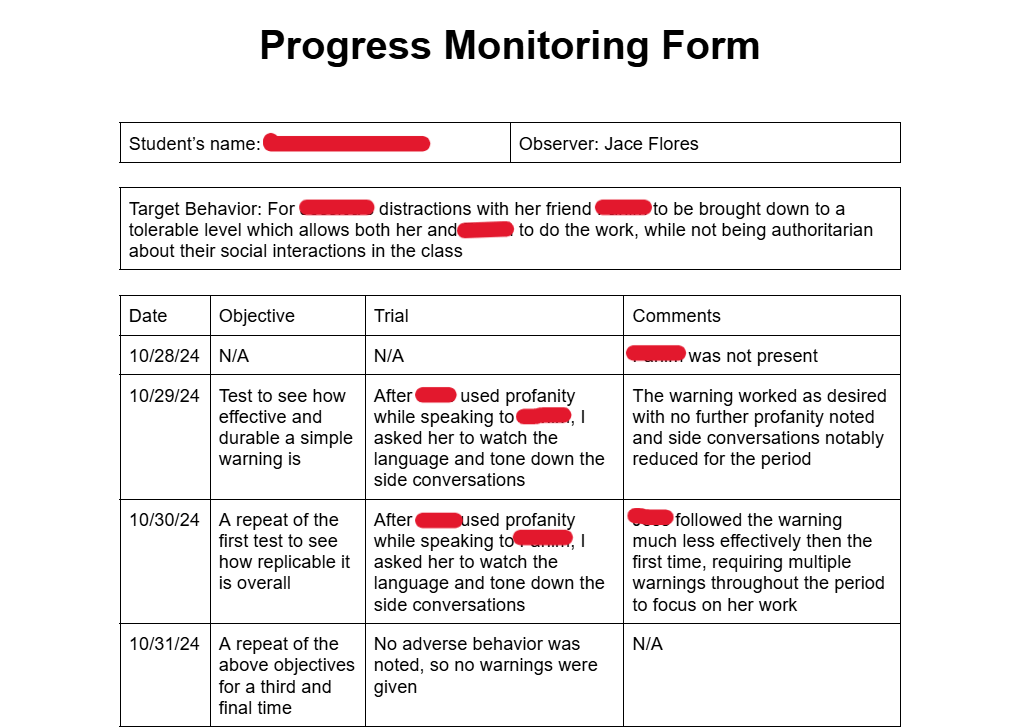
    Something we covered with Professor Phuong was the concepts of a Functional Behavioral Assessment and Progress Monitoring. Above is a picture of the Progress Monitoring I did with a student of mine. The idea of Progress Monitoring is you take a student who could be doing better in some regard, identify what specifically you want to accomplish in improving them, and essentially test out ways to get that student where you want them to be. So for example with my Progress Monitoring effort I wanted the student to be better focused on the work she had while simultaneously not being overbearing with controlling every social interaction she had. Based on this premise I tried out different ways to get her to have better results with focusing on her work while still overall respecting her social life with her adjacent best friend. The Progress Monitoring only went on for a week so the results were not incredibly conclusive, but it was a taste of putting the ideas that Professor Phuong mentioned into practice. If I spent more time on this I would have done multiple trials of each idea to see what worked best and to better scrutinize the difference in work focus and quality. I will say, however, that from what I observed there was fairly noticeable improvement when trying certain ideas.

    December 14, 2024

  • Disciplining

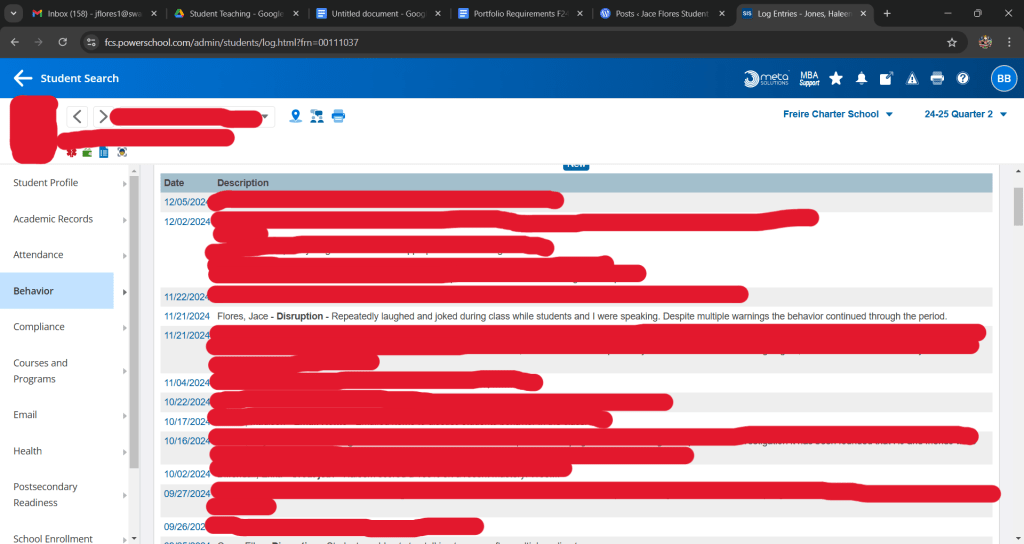
    Probably the least savory thing about teaching is disciplining, especially if you have to write up students that you like. My general philosophy with disciplining is I try to give the kids as many exit strategy opportunities as possible, as one may call it in geopolitical terms. With how important relationships are, writing up a kid feels awkward, it feels bad and it could very well sour something that was going fairly well up to that point. So I usually start off by trying to ignore it, maybe have a general class call of attention so that there is no need to single out kids. If the distractions or issues at hand continue then I’ll escalate to singling out kids to have their attention and cooperation. If that does not work, that is when I will get to writing up kids. Now I have had only one day where it felt necessary to write up kids, and the above picture is an example of a log I did for a student whose information has been redacted as you can see. I gave them every opportunity to not have to deal with a write up, the opportunities were squandered and the punishment was meted. While admittedly there was some catharsis, I mostly felt negative about the whole thing, because these are kids I like. But I think this illustrates the importance of good relationships with clear student-teacher boundaries.

    December 14, 2024

  • Writing & Research

    Something I have mentioned in other posts is I like the kids to do assignments where they are writing a little bit. This post will emphasize the more technical importance of this, particularly from the perspective of developing skills. What I try to do once a week is have the students do some sort of writing assignment where they have to write at least a paragraph of content. This can range from a creative writing assignment to researching a specific topic or topic of their choosing, but the goal is to get the kids to practice writing. As someone who just went through 4 years of college and had to write six trillion essays, I understand how important it is to be able to write a good essay. By having these kids practice writing with me giving specific parameters/structures (eg I want a paragraph to have 1 intro sentence, 4-5 fact sentences and 1 conclusion sentence) I hope to build up their ability to write. If they can write a good paragraph, they can write a good essay. If they can write a good essay, they can get a good college grade. Simple math in my opinion. While the kids certainly bemoaned this, I do hope the regular practice helped strengthen their writing a bit, though I did not do this enough to see a clear change in their overall writing quality.

    December 13, 2024

  • Entertainment as Education

    Probably the one universal thing which connects all American history classes together is the movie Glory. Just about every high school shows it once a year during the Civil War unit, treating it as the gold standard for portraying the Civil War. And I agree! I was a big fan of this movie well before doing this program and it made sense that Brian’s 10th grade classes would see this flick as part of his curriculum. There are a couple reasons why I adopted it for mine. I think I stand out a bit from many other history teachers in being both a cinephile and a history buff, so for me it comes very naturally to try to combine those two into an educational experience. I value movies because I think they display imagery and convey emotions that are hard to replicate in most other formats. They are a way to immerse the viewers into a completely different world. Glory to me is excellent because it captures a lot of what the Civil War was about, why people were fighting, what they were fighting for, the optimists, the cynics and everyone in between. It excellently distills this massive conflict into a 3 hour or so movie and helps the viewer visualize the conflict excellently. This is why I decided to incorporate Glory into my curriculum, not to follow the grain but because of genuine merits I think there are in using movies to display time periods that are otherwise difficult to really grasp.

    December 13, 2024

  • Learning The People

    Perhaps this does not fit the category to a T, but I think it is worth talking about anyways. It is obvious that when it comes to learning in school the immediate thought is learning content in some way, which makes sense given it is the primary purpose of school. However, I think an integral part of school is learning the people. The teachers are not just spewers of facts and the students are not just receptables of facts. They are all full humans, and I think people like to hear about each others lives.

    Now it is not that everyone needs to know the major truths of everyone around them. I don’t think it would be wise for everyone to go trauma dumping or long soliloquys on how we became the people we are today. At the same time, it is fun when we learn little things about each other. What we like to do for fun, the little quirks we have, the pets we care for, thoughts on the best restaurant in the area, etc. These little factoids build rapport and build towards that community I love to mention so so so much in these blog posts. Learning about each other makes it easier to learn about the content because there is that bond and connection. The connection of being actually human. I mean who has not thought before how a fair few teachers we have come off more like robots then real people? Piercing through that help makes for a richer learning experience in the actual knowledge being taught.

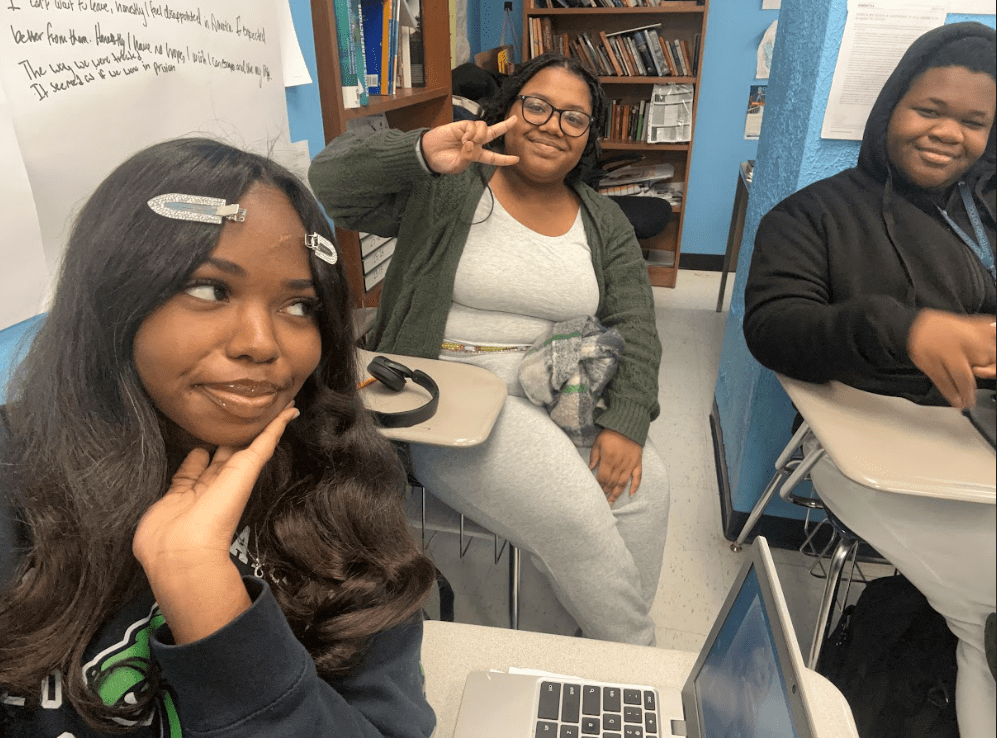
    I don’t think the selfie posted above that was taken for me to remember this trio would be possible if we did not have mutual learning about each other. Why the hell would they care about me enough to take a selfie if they knew nothing about me as a person? And when I see this picture I immediately recall all the intricacies these three have because I learned about them as well. The worth of this is seen in the comments students like this left for me after my last day, where among compliments of my affability were compliments of teaching them. I think that is a clear vindication of the importance of learning about each other as people in order to learn the content to its fullest extent.

    December 13, 2024

  • Grading

    I think there is no thing both kids and parents are sensitive to then grades. It makes sense, after all these little data points control the outcomes these students have in their academic career. Each number put in nudges each kid’s future in one direction or another. So grading is a very important thing that in my experience requires both a formulaic side and a nuanced side to keep things reasonable for what the kids receive. For most assignments the foundation of my approach was to set up a basic formula.

    For instance, lets say an assignment is worth 10 points and that assignment had 5 questions. Each question is worth 2 points, and for each question the kid answered adequately they get 2 points. This I found to be simple yet effective enough to be grading ~90 sheets a day. However, nuances are required. Say a kid is SS. Then it is reasonable to not expect all 5 questions to be answered and instead grade them on, say, 2-3 questions (guiding them to which questions are most important of course). Or if there was simply not enough time to reasonably expect the kids to get to all 5, then I would grade on 3-4 questions. There may also be personal modifications. If a kid does not get to all the questions but participated well in a class discussion or warmup, it doesn’t hurt to give them a point or two. Or if a kid is having a bad day, why make their day worse with a 0?

    In consultation with Brian, this grading schematic proved to work well in effectively grading the kids based on various factors, with nothing unjustified. If a kid got a 0, I could easily explain why. If a kid got a 10, I could also easily explain why. There were plenty of opportunities for the kids to make up work as well and boost their grade. A low grade was not necessarily final.

    December 11, 2024

  • Average Content

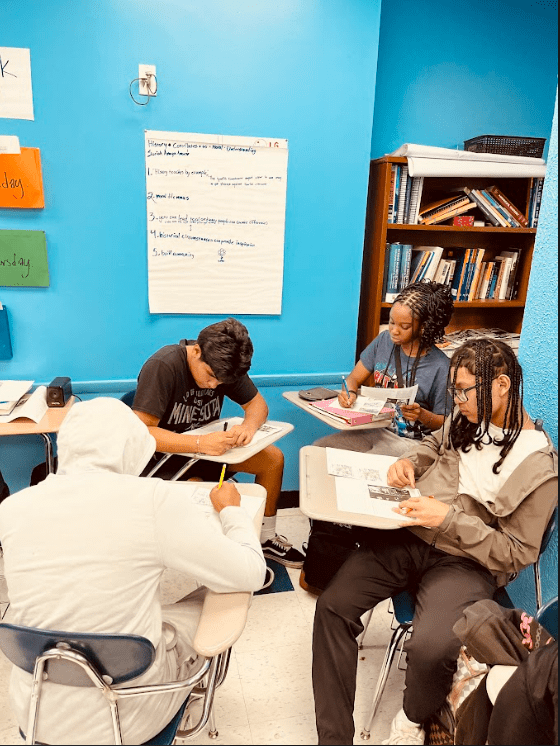
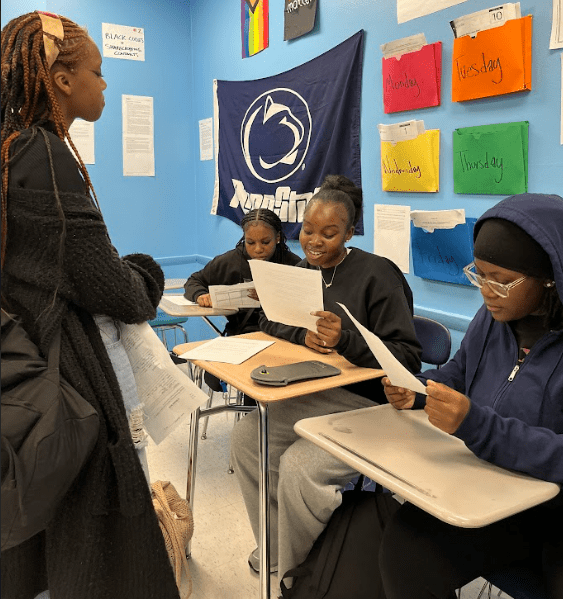
    The average work the students did in class was group work on a packet. These packets were usually based either on content provided by TCI (which Brian has access to) or more likely based on history articles I found that better fit my vision. These packets either focused on a single topic or had multiple topics in its contents depending on the vision of the lesson. Usually the articles were secondary sources, though occasionally I did a primary source packet lesson. The packets the groups and individuals received may also be different depending on the activity. Sometimes everyone across the board got the same packet. Sometimes each group got a different packet, usually for jigsawing as class. Other times every individual in each group would get a different packet, usually for jigsawing as a group. Regardless of the structure of the packets and who got what, the kids were also provided worksheets to answer questions and get the main things I wanted them to get. Usually these worksheets were made by me.

    There are multiple reasons Brian and I embraced this group packet genre of teaching. The first is it allows for more personal attention to the students if they have questions. When they work in these groups I can interact with them more closely and give them more attention in that moment to answer their questions. The second is the kids interact and work with others in completing the packet, strengthening their cooperation skills which is important because in life people rarely go at things alone. The third is it encouraged reading and writing skills, as the kids encountered new words and had to write healthy sentences to satisfy the questions. The fourth, and more personal, is it made it easier for me to handle my anxieties. Speaking in front of 30 kids for an hour is a lot! But with the packets I could handle the kids one group of 4-6 at a time which I found much more manageable and not terribly stressful.

    December 9, 2024

Next Page

Blog at WordPress.com.


Loading Comments...
 

    • Subscribe Subscribed
      • Jace Flores Student Teacher Blog
      • Already have a WordPress.com account? Log in now.
      • Jace Flores Student Teacher Blog
      • Subscribe Subscribed
      • Sign up
      • Log in
      • Report this content
      • View site in Reader
      • Manage subscriptions
      • Collapse this bar