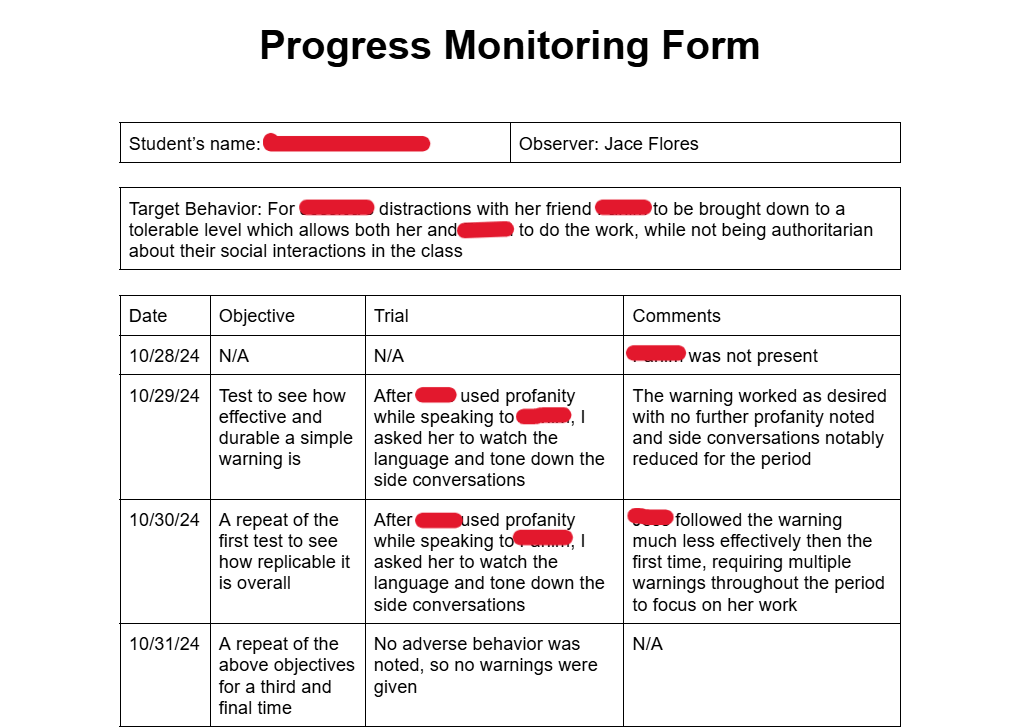
Something we covered with Professor Phuong was the concepts of a Functional Behavioral Assessment and Progress Monitoring. Above is a picture of the Progress Monitoring I did with a student of mine. The idea of Progress Monitoring is you take a student who could be doing better in some regard, identify what specifically you want to accomplish in improving them, and essentially test out ways to get that student where you want them to be. So for example with my Progress Monitoring effort I wanted the student to be better focused on the work she had while simultaneously not being overbearing with controlling every social interaction she had. Based on this premise I tried out different ways to get her to have better results with focusing on her work while still overall respecting her social life with her adjacent best friend. The Progress Monitoring only went on for a week so the results were not incredibly conclusive, but it was a taste of putting the ideas that Professor Phuong mentioned into practice. If I spent more time on this I would have done multiple trials of each idea to see what worked best and to better scrutinize the difference in work focus and quality. I will say, however, that from what I observed there was fairly noticeable improvement when trying certain ideas.
For my Microteach I decided to teach about the Articles of Confederation.
I started with a warmup asking the students to make their own set of laws as if they were leading their own newly independent nation. They could work with a partner or buy themself, and have some of the students share out what they wrote as a simple participation effort.
The next section was a historical lecture on the Articles of Confederation, starting with the background (namely what led to the outbreak of the American Revolution), then what the goals of the Articles of Confederation were, and ending with how the articles were implemented and eventually suspended and superseded by the Constitution.
The culmination of the lesson is a simulation where the kids would be divided into groups, with one group representing the federal government and the other groups being different states. Every group would be given objectives that they had to accomplish as well as parameters for how they could operate (particularly the Feds who are purposefully hamstrung). A state group would go up to the federal group and pitch their problem and possible solution, with the Feds having to try and resolve the issue while sticking to their parameters. The goal of the simulation is for the Feds group to deliberately fail in order to highlight how the Articles of Confederation were doomed.
After the simulation there would be another mini lecture breaking down in more detail why the articles failed and how that led to the Constitution.
Overall I think this microteach is a glimpse into a past sense of how I actually like to teach. My time at Freire has been quite illuminating on how to avoid lecture and emphasize group work over teacher-class work. However, I do think the creativity I have is evident in the simulation which if actually practice I think would have been quite fun. Unsurprisingly the content is quite good and I think any students who participated in it would have been quite informed and hopefully had a little fun even with the lecture emphasis for much of it.
This book is a pretty nifty guide on how to cover the different facets of history by looking at case studies and picking them apart to reveal important lessons and questions to teach and understand history.
The first chapter discussed the Pocahontas-John Smith story. It is a good start because it allows questions to be asked about what history is, what sources are and how history is a constantly evolving subject, while being a topic people are broadly familiar with due to its cultural importance.
The second chapter discussed the Battle of Lexington. This was chosen to mainly look at what narratives are probable/definitive, and which ones are weak or otherwise have little substance to them through looking at primary sources. It also provided an opportunity to look at how myth, intentions and history interact.
The third chapter discusses Lincoln’s views on slavery. It calls for careful analysis of contemporary sources of both the subject in question and the people around them. It also calls for understanding the context he existed in and judging whether one should be viewed relative to their time or relative to the modern day.
The fourth chapter discussed Benjamin Harrison’s declaration founding Columbus Day. This section focused on why the declaration happened and how different groups interpreted the declaration differently. Those with fewer historical skills looked at the immediate subject of the declaration while historians looked at the greater context.
The fifth chapter discusses a letter a rich rural housewife sent to Thomas Edison in 1921. It requires that students look at the greater historical perspective beyond what one primary source provides. This in turn leads to comparing other perspectives via the use of other primary sources and statistics.
The sixth chapter discusses the Dust Bowl and why it happened. There is a focus on using stories, a valid medium of information, to try and find out why exactly something happened. This can lead to different interpretations of the same facts, particularly as modern issues grow more or less relevant.
The seventh chapter discusses Rosa Parks and the facts surrounding her story. This is taught to put facts into the myths by figuring out what actually happened in a story as popular as this. It also looks at how history can remember or forget key individuals, as well as looking at how social movements have worked in history.
The eighth and final chapter discusses the Cuban Missile Crisis and whether it’s end was an American victory or quid pro quo. While being another example of corroboration, this chapter emphasizes the importance of the passage of time which tends to reveal new information, and what lessons to draw from the new history.
As these chapters demonstrate, there are a wide variety of techniques which can be used to analyze history and get the full set of facts, perspectives and ideas that are buried in each event or idea. The chapter provides a series of possible lesson plans as well to help further extract these techniques for students, something that could be useful to copy or reference for preparing my own lessons.


 Jace Flores Student Teacher Blog