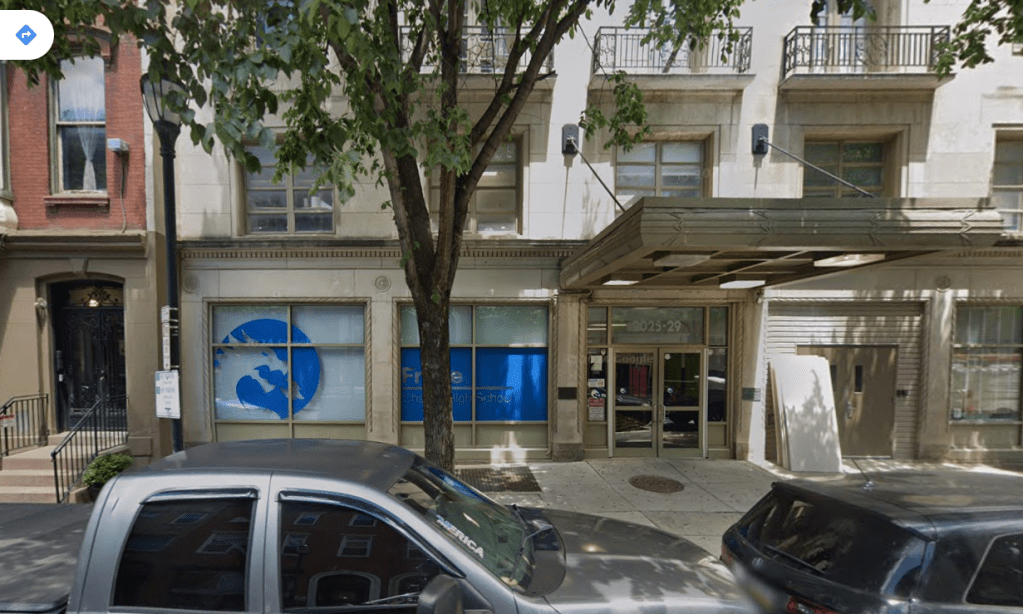
The neighborhood the school is located in is quite nice, being just west of town hall. The street is pretty business oriented (or mixed use, something rather rare in LA) with a lot of restaurants that are pretty delicious thus far. The kids are allowed to leave the school and get lunch from around the area, which I speaks to the safety of the area.
Demographically the student body is overwhelmingly African American with a very small group of Hispanics. I have been meaning to ask how exactly that is determined (why not go all in on African Americans?), but alas it has slipped my mind. Gender wise it looks pretty fifty-fifty. The kids are from various different neighborhoods across the city, some neighborhoods being better then others (and a nifty geography lesson).
Freire has a very clear, concise and tangible overarching goal with its focus on preparing students for college, which is supported by emphasizing less tangible ideas. I think this two track approach makes sense in balancing the sort of physical with the psychological. Without going to college the ideas of critical thinking and problem solving cannot reach their full potential as these ideas work best with more education and opportunities of work and pursuit. However, without these ideas a college education is mitigated in its potential usefulness as one simply goes through the motions to pursue something banal and non-challenging. I think these two tracks are a sort of symbiotic relationship for unlocking the full potential of a person.
The facts emphasize that the approach Freire takes is one that leads to success. 100% of 2023 students being accepted into colleges, $8 million in college scholarships and financial aid, above average college retention rate. These simple facts highlight that, one does not necessarily need to understand what exactly Freire is doing to see that their model is a successful one.
The first thing that stood out to me with the curriculum is the mix of class options to meet the levels the students are at, particularly in 11th and 12th grades. There are honor/AP classes for the students who are really excelling in a domain, and classes that are not as intense but are still very useful for college preparation and life. The personal finance & entrepreneurship class sticks out in particular for me as a highly useful class which I wished was at my high school. I also noticed the electives are tailored for students to be able to interact with their own cultures as there are a host of African American electives offered, which makes sense given the student body is 94% African American. Lastly, I noticed there is some sort of class called crew which seems rather unique to me, or at least I have never seen it before. While building culture/community and preparing soft skills for college is pretty explanatory, I wonder what is meant by socio-emotional curriculum.
Like the mission, the culture that Freire has is very concise in its goal, namely having an environment of peace and safety. Now everyone likes those sort of ideas and in that way Freire is not unique, but where I think it stands out and is arguably more genuine is that this culture was built from experience. Their first class expressed the dangers of the outside world and the school worked to try and incorporate this information, perhaps not even being prepared for such when starting the school and indicating genuine change and adaptation. The extensive avenues for help is also noteworthy as it indicates the school is very serious about being able to address the issues of the students from a wide degree of angles and approaches.
With regards to the school itself, the physical place, I noticed that it was quite symmetrical going from floor to floor. Each floor has a central hall with lockers through doorways on either side were the classrooms. I certainly appreciated this after being in some schools with rather confusing layouts. While the hallways were rather plain the classrooms were not, each being arranged and decorated per the subject and teacher(s) which occupied that classroom. Nothing particularly stand out, but I think it was good to see the personality come out within each classroom.
When it comes to myself fitting in this system my intention is to keep an open mind and see what I think works and what does not. I certainly have my own convictions, but I think it would be wise for someone green like me to act as if I am a blank slate. I will say I am quite fond of the dual track approach mentioned at the start and see how that is exactly implemented to yield the results Freire rightfully shows off. In general the things I read and saw were intriguing if not persuasive, and it will be interesting to have a front row seat in seeing how these are implemented and how they pay off.
In terms of me joining this community with my own identity, on one hand I am very unfamiliar with African American culture (which I do use to get to know the kids by playing the hopelessly uninformed goober) and their home lives. Perhaps the worst of this is names, AA naming convention just kinda does not make sense to me and requires me to practice a lot to maybe say the name right. On the other hand I think it is nice that I am pretty close to their age so I “get” being a high school student and using that to my advantage. There is also plenty of cultural overlap from this age similarity (obviously it is not like AA culture and broader American culture are two completely distinct entities), which helps getting to know the kids and such.
 Jace Flores Student Teacher Blog